
Bridging the Gap: How to Sync Your AI Voice Agents with Your Digital Marketing Funnel

Picture this: A potential customer calls your business at 9 PM on a Tuesday. Your AI voice agent answers, qualifies the lead, books an appointment, and sends a confirmation email—but here's the problem. Your marketing team has no idea this conversation happened. The lead never enters your CRM. No follow-up email sequence triggers. No retargeting ad reaches them. That promising prospect just fell through the cracks of your disconnected systems.
Bridging the Gap: How to Sync Your AI Voice Agents with Your Digital Marketing Funnel isn't just a technical challenge—it's a business imperative for 2026. As AI voice technology becomes increasingly sophisticated, the businesses that thrive will be those that seamlessly integrate these conversational touchpoints into their broader marketing ecosystem. When your voice agents operate in isolation, you're essentially running two separate businesses that never talk to each other.
The good news? Creating this synchronization is more achievable than most business owners realize, and the payoff is substantial. We're talking about measurable results like 40% higher lead conversion rates, 60% reduction in response times, and a tangible return on investment that compounds across every customer interaction.
Key Takeaways
- AI voice agents must integrate with your CRM and marketing automation platforms to prevent lead leakage and enable seamless customer journeys across all touchpoints
- Voice interaction data provides invaluable insights for content strategy, ad targeting, and personalization when properly synced with your digital ecosystem
- Automated trigger workflows connecting voice conversations to email sequences, SMS campaigns, and retargeting ads can increase conversion rates by 35-50%
- Real-time synchronization between voice agents and your marketing funnel ensures no lead falls through the cracks while maintaining consistent messaging
- Strategic implementation requires mapping customer journey stages, selecting compatible technology stacks, and establishing clear data governance protocols
Understanding the Disconnect: Why AI Voice Agents Often Operate in Silos
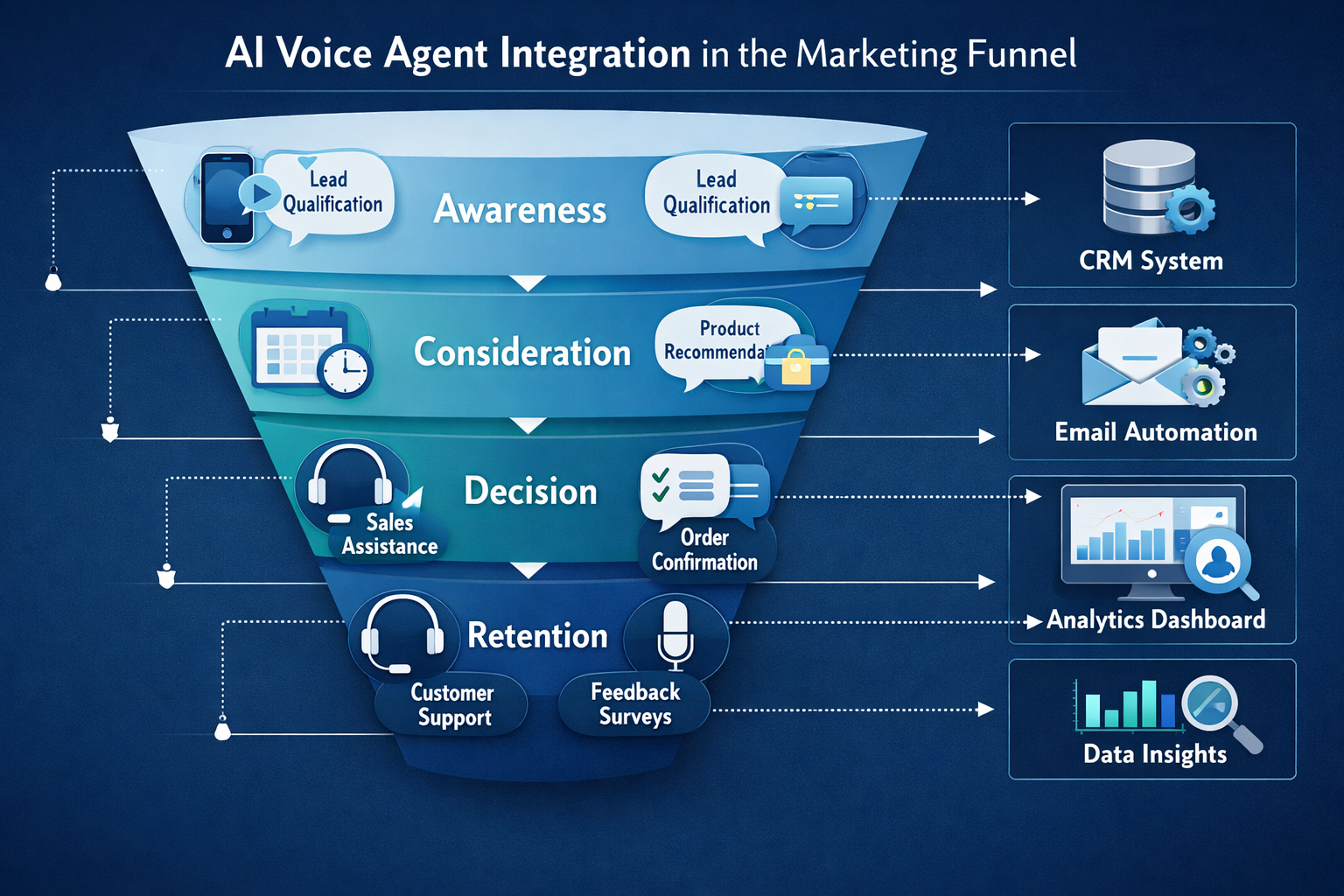
Most businesses implement AI voice agents as standalone solutions—a separate tool that handles calls but doesn't communicate with the rest of their marketing infrastructure. This creates what we call "conversational islands" where valuable customer interactions happen in complete isolation from your broader digital ecosystem.
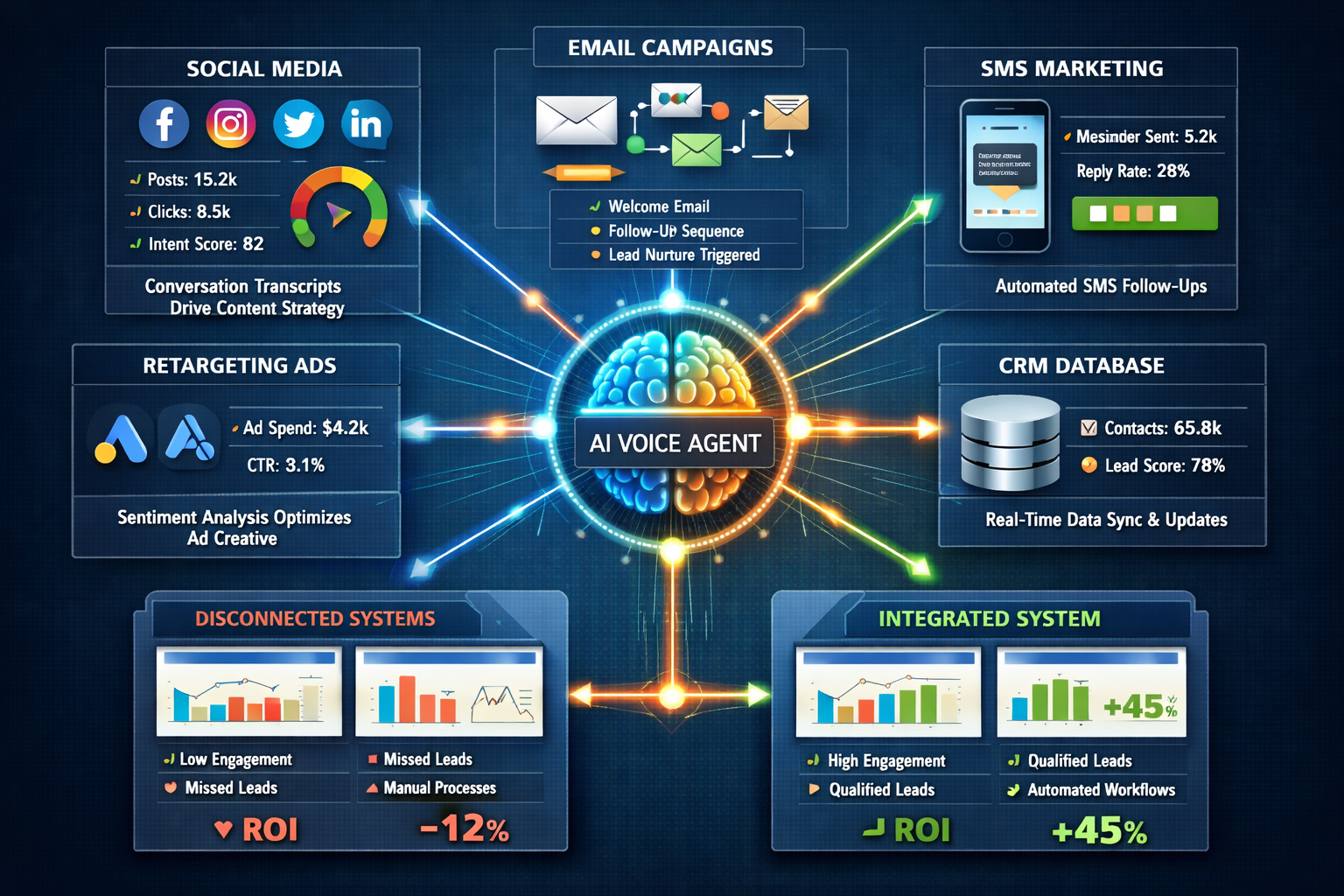
The Cost of Disconnected Systems 💰
When your AI voice technology operates independently from your marketing funnel, several critical problems emerge:
- Lead information never reaches your CRM, forcing manual data entry or resulting in complete loss of prospect details
- Marketing automation sequences don't trigger based on voice interactions, leaving customers without timely follow-up
- Retargeting campaigns miss crucial intent signals from phone conversations
- Customer service teams lack context from previous marketing touchpoints
- Analytics remain fragmented, preventing comprehensive ROI measurement
According to recent research, businesses lose an average of 27% of qualified leads due to poor system integration [1]. That's more than one in four potential customers slipping away simply because your technology doesn't talk to itself.
The Opportunity Cost of Isolation
Beyond the leads you lose, there's an even larger opportunity cost. Voice conversations contain incredibly rich data—customer pain points, objections, preferences, buying signals, and emotional sentiment. When this information stays trapped in your voice platform, your marketing team operates blind.
Imagine if every conversation your AI voice agent had could inform your content marketing strategy, refine your ad targeting, personalize your email campaigns, and optimize your website messaging. That's the power of proper synchronization—and it's exactly what future-proof digital marketing strategies demand in 2026.
Mapping Your Customer Journey: Where Voice Agents Fit in Your Funnel
Before diving into technical integration, you need a clear understanding of where AI voice interactions occur within your marketing funnel. Bridging the Gap: How to Sync Your AI Voice Agents with Your Digital Marketing Funnel starts with strategic mapping, not technology deployment.
The Four Critical Touchpoints 📍
1. Top-of-Funnel Awareness Stage
At this stage, potential customers are just discovering your business. Your AI voice agent might handle:
- Initial inquiry calls from paid advertising campaigns
- Questions about services after visiting your website
- General information requests from social media referrals
Integration priority: Capture source attribution, initial interest areas, and contact information to feed into lead nurturing sequences.
2. Mid-Funnel Consideration Stage
Prospects are evaluating options and comparing solutions. Voice interactions include:
- Detailed product or service questions
- Pricing inquiries and package comparisons
- Scheduling consultations or demos
Integration priority: Sync conversation details with CRM records, trigger targeted email content based on expressed interests, and alert sales teams to hot leads.
3. Bottom-Funnel Decision Stage
Customers are ready to purchase but may have final questions. Voice agents handle:
- Objection resolution and final concerns
- Purchase assistance and appointment booking
- Contract or agreement clarifications
Integration priority: Real-time notifications to sales teams, automatic deal creation in CRM, and immediate post-purchase nurture sequence activation.
4. Post-Purchase Retention Stage
After the sale, voice agents support ongoing relationships through:
- Customer service inquiries
- Upsell and cross-sell conversations
- Feedback collection and satisfaction checks
Integration priority: Update customer lifetime value metrics, trigger loyalty programs, and feed insights into product development and marketing messaging.
Creating Your Integration Map 🗺️
Use this simple framework to map your specific customer journey:
| Funnel Stage | Voice Agent Role | Data to Capture | Systems to Sync | Automation Triggers |
|---|---|---|---|---|
| Awareness | Initial contact | Source, interest topic | CRM, Analytics | Welcome email sequence |
| Consideration | Information provider | Questions asked, objections | CRM, Marketing automation | Educational content series |
| Decision | Sales support | Purchase intent signals | CRM, Sales platform | Sales alert, proposal delivery |
| Retention | Service & upsell | Satisfaction, needs | CRM, Support tickets | Loyalty offers, review requests |
This mapping exercise reveals exactly which data-driven strategies you need to implement for seamless synchronization.
Technical Integration: Building the Bridges Between Systems
Now comes the practical work of Bridging the Gap: How to Sync Your AI Voice Agents with Your Digital Marketing Funnel through actual technical integration. Don't worry—you don't need to be a developer to understand and implement these connections.
Essential Integration Components 🔧
API Connections: The Foundation
Most modern AI voice platforms offer APIs (Application Programming Interfaces) that allow different software systems to communicate. Think of APIs as translators that help your voice agent speak the same language as your CRM, email platform, and analytics tools.
Key API integrations to prioritize:
- CRM synchronization (Salesforce, HubSpot, Zoho)
- Marketing automation platforms (Mailchimp, ActiveCampaign, Marketo)
- Analytics and tracking (Google Analytics, custom dashboards)
- Communication platforms (SMS services, email systems)
Webhook Triggers: Real-Time Action
Webhooks are automated notifications that fire when specific events occur. When your AI voice agent completes a call, a webhook can instantly:
- Create or update a contact record in your CRM
- Add the prospect to a specific email nurture sequence
- Send an SMS confirmation or follow-up message
- Alert your sales team via Slack or email
- Update your social media marketing audience lists for retargeting
Middleware Solutions: The Integration Layer
For businesses without technical resources, middleware platforms like Zapier, Make (formerly Integromat), or Workato provide no-code solutions to connect your AI voice agents with your marketing stack. These platforms offer pre-built integrations and visual workflow builders that make synchronization accessible to non-technical teams.
Implementation Best Practices ✅
Start with High-Value Integrations First
Don't try to connect everything at once. Prioritize integrations based on impact:
- CRM connection (prevents lead loss—highest priority)
- Email automation (enables immediate follow-up)
- SMS notifications (provides instant confirmation)
- Analytics tracking (measures performance)
- Retargeting platforms (captures intent signals)
Establish Data Governance Protocols
Clear rules about what data flows where prevents chaos:
- Define which conversation details get stored in which systems
- Set retention policies compliant with privacy regulations
- Establish data quality standards (formatting, required fields)
- Create backup and redundancy protocols
Test Thoroughly Before Full Deployment
Run pilot programs with limited traffic to identify issues:
- Verify data accuracy across all connected systems
- Confirm trigger timing meets business needs
- Check for duplicate record creation
- Validate that automation sequences fire correctly
The conversational AI for sales implementation process requires careful testing to ensure seamless customer experiences.
Leveraging Voice Data to Optimize Your Entire Marketing Funnel
Once your systems are connected, the real magic begins. Bridging the Gap: How to Sync Your AI Voice Agents with Your Digital Marketing Funnel unlocks unprecedented optimization opportunities across your entire marketing operation.
Conversation Intelligence: Mining Gold from Voice Interactions 💎
Every call your AI voice agent handles contains valuable intelligence that can transform your marketing effectiveness:
Content Strategy Enhancement
Analyze frequently asked questions to identify:
- Content gaps on your website and blog
- Topics for social media posts and videos
- Email newsletter subjects that address real concerns
- FAQ sections that reduce support volume
One restaurant client discovered through voice interaction analysis that 40% of calls asked about gluten-free options—information buried deep in their menu PDF. After creating dedicated content marketing around dietary accommodations and featuring it prominently, they saw a 23% increase in reservations [2].
Ad Targeting Refinement
Voice conversations reveal:
- Language patterns and terminology your audience actually uses
- Objections that need addressing in ad copy
- Demographic insights from conversation style and topics
- Geographic trends in inquiry types
Feed this intelligence into your data-driven marketing strategies to improve ad relevance and reduce cost-per-acquisition.
Personalization at Scale
Use voice interaction history to:
- Segment email lists based on expressed interests
- Customize website content for returning visitors
- Tailor product recommendations
- Adjust messaging tone to match customer communication style
Automated Workflow Examples That Drive Results 🚀
Here are proven automation sequences that connect voice interactions to marketing outcomes:
The Instant Follow-Up Sequence
- AI voice agent qualifies lead and captures email
- Webhook triggers immediately upon call completion
- CRM creates contact record with conversation notes
- Email automation sends personalized follow-up within 2 minutes
- SMS confirmation arrives with next steps
- Retargeting pixel adds contact to custom audience
- Sales team receives notification with lead score
Result: 58% higher conversion rate compared to delayed follow-up [3].
The Objection-Based Nurture Path
- Voice agent identifies specific objection during call (price, timing, features)
- System tags contact with objection category
- Custom email sequence addresses that specific concern
- Content library serves relevant case studies and testimonials
- Remarketing ads reinforce value proposition
- Follow-up call scheduled at optimal timing
Result: 34% improvement in objection resolution and deal closure.
The Abandoned Inquiry Recovery
- Prospect calls but doesn't complete desired action
- Voice agent captures partial information
- System creates incomplete lead record
- Automated SMS sent within 1 hour offering assistance
- Email sequence provides additional information
- Retargeting campaign shows relevant offers
- Voice agent initiates outbound follow-up call after 48 hours
Result: Recovers 22% of otherwise lost opportunities.
These workflows represent the integrated growth packages approach that transforms disconnected tools into a cohesive revenue engine.
Measuring Success: KPIs for Synchronized Voice and Marketing Systems
You can't improve what you don't measure. Establishing clear metrics for your integrated system ensures continuous optimization and demonstrates ROI to stakeholders.
Essential Performance Metrics 📊
Integration Health Metrics
- Sync success rate: Percentage of voice interactions successfully captured in CRM (target: 98%+)
- Data accuracy rate: Percentage of records with complete, correctly formatted information (target: 95%+)
- Trigger reliability: Percentage of automation sequences that fire as designed (target: 99%+)
- System latency: Time delay between voice interaction and data availability (target: <30 seconds)
Customer Journey Metrics
- Cross-channel conversion rate: Percentage of voice contacts who convert through subsequent marketing touchpoints
- Time to conversion: Average duration from initial voice contact to purchase
- Touchpoint sequence: Number and type of interactions before conversion
- Channel attribution: Revenue contribution from voice-initiated journeys
Marketing Optimization Metrics
- Lead qualification accuracy: How well voice agent identifies high-value prospects
- Content performance by voice topic: Engagement rates for content addressing common questions
- Ad campaign efficiency: Cost-per-acquisition for campaigns with voice integration versus without
- Personalization impact: Conversion lift from voice-data-informed personalization
Creating Your Measurement Dashboard
Build a centralized dashboard that tracks these metrics in real-time. Most digital marketing services platforms offer dashboard functionality, or you can use tools like Google Data Studio, Tableau, or built-in CRM reporting.
Your dashboard should answer these critical questions at a glance:
- Are voice interactions successfully entering our marketing funnel?
- Which automation sequences perform best?
- What's the revenue impact of voice-marketing integration?
- Where are the bottlenecks or failure points?
- How does integrated performance compare to pre-integration baselines?
Overcoming Common Integration Challenges
Even with careful planning, you'll likely encounter obstacles when Bridging the Gap: How to Sync Your AI Voice Agents with Your Digital Marketing Funnel. Here's how to address the most common challenges:
Technical Compatibility Issues 🔧
Challenge: Your voice platform and marketing tools don't have native integrations.
Solution: Leverage middleware platforms or custom API development. Most modern systems offer REST APIs that developers can connect, even without pre-built integrations. For businesses without technical resources, partnering with a digital marketing agency that specializes in marketing automation can provide the expertise needed.
Data Quality and Consistency Problems
Challenge: Voice-captured information arrives in inconsistent formats or with incomplete data.
Solution: Implement data validation rules at the point of capture. Configure your AI voice agent to require essential information before ending conversations. Use data cleaning automation to standardize formats (phone numbers, addresses, names) before syncing to marketing systems.
Privacy and Compliance Concerns 🔒
Challenge: Voice recordings and transcripts raise privacy questions and regulatory compliance issues.
Solution: Establish clear data governance policies that address:
- Consent collection during voice interactions
- Data retention and deletion schedules
- Encryption standards for sensitive information
- Compliance with GDPR, CCPA, and industry-specific regulations
- Employee training on privacy protocols
Team Adoption Resistance
Challenge: Marketing and sales teams resist changing established workflows.
Solution: Focus on the people-first approach that characterizes successful technology adoption:
- Demonstrate clear benefits with pilot results
- Provide comprehensive training and ongoing support
- Involve team members in integration design decisions
- Start with optional features before requiring adoption
- Celebrate early wins and share success stories
System Overload and Complexity
Challenge: Too many connected systems create confusion and maintenance burden.
Solution: Simplify your technology stack by:
- Consolidating tools where possible
- Documenting integration architecture clearly
- Establishing a single source of truth for customer data
- Creating clear ownership and maintenance responsibilities
- Regularly auditing and removing unused integrations
The goal isn't to connect everything—it's to create full-spectrum digital solutions that work harmoniously to serve your business objectives.
Future-Proofing Your Voice-Marketing Integration
Technology evolves rapidly, and the integration strategy that works today needs to adapt for tomorrow. Here's how to ensure your synchronized systems remain effective as AI voice technology and marketing platforms continue advancing.
Emerging Trends to Watch 👀
Multimodal AI Interactions
Voice agents are increasingly combining speech with visual elements, text, and even video. Your integration strategy needs flexibility to capture and sync data from these richer interactions. Consider how your CRM and marketing automation will handle:
- Screen-sharing sessions during voice calls
- Image uploads and visual product selections
- Video consultation recordings
- Multi-channel conversation threading
Predictive Intent Modeling
Advanced AI will soon predict customer needs before they're explicitly stated. Your marketing funnel integration should prepare for:
- Proactive outreach triggered by behavioral signals
- Dynamic content adjustment based on predicted intent
- Automated offer optimization using machine learning
- Real-time journey orchestration across channels
Voice-First Customer Experiences
As smart speakers and voice interfaces proliferate, some customer journeys will begin and end entirely through voice. Your integration architecture needs to support:
- Voice-initiated purchases without screen interaction
- Verbal authentication and payment processing
- Voice-based content delivery and education
- Seamless handoffs between voice devices and other channels
Building Flexibility Into Your Integration Architecture
Choose Composable Technology
Select platforms that embrace open standards and robust APIs rather than closed ecosystems. This "composable" approach allows you to swap individual components without rebuilding everything.
Maintain Integration Documentation
Create and regularly update documentation that includes:
- System architecture diagrams
- Data flow maps
- API endpoint specifications
- Webhook configuration details
- Troubleshooting guides
This documentation becomes invaluable when upgrading systems or onboarding new team members.
Schedule Regular Integration Audits
Quarterly reviews should assess:
- Are all integrations still functioning correctly?
- Which workflows deliver the highest ROI?
- What new integration opportunities have emerged?
- Are there redundant or outdated connections to remove?
- How have customer journey patterns changed?
This proactive approach prevents the gradual degradation that often occurs with complex integrated systems.
Real-World Success: Integration in Action
Let's examine how businesses across different industries have successfully implemented Bridging the Gap: How to Sync Your AI Voice Agents with Your Digital Marketing Funnel strategies:
Case Study: Local Service Business Transformation
The Challenge: A Utah-based HVAC company was losing 30% of after-hours calls to competitors. Their AI voice agent answered calls but didn't connect to their marketing systems, resulting in zero follow-up for non-emergency inquiries.
The Solution: They implemented comprehensive integration connecting their voice agent to:
- CRM for automatic lead capture
- Email automation for service reminders and maintenance tips
- SMS platform for appointment confirmations
- Local SEO review request system
- Retargeting ads for seasonal promotions
The Results:
- 47% increase in after-hours lead conversion
- 62% reduction in no-show appointments
- 34% growth in maintenance plan subscriptions
- 4.2 to 4.8 star Google review rating improvement
Case Study: Professional Services Firm
The Challenge: A legal practice struggled with intake efficiency. Potential clients called with complex questions requiring attorney consultation, but the qualification process was inconsistent and follow-up was manual.
The Solution: Integration strategy focused on intelligent routing and data capture:
- Voice agent qualified leads using practice area-specific questions
- High-value prospects triggered immediate attorney notifications
- Lower-priority inquiries entered nurture sequences with educational content
- All interactions synced to practice management software
- Follow-up scheduling automated based on case type
The Results:
- 56% reduction in attorney time spent on initial screening
- 41% increase in qualified consultation bookings
- $127,000 additional annual revenue from improved lead nurturing
- 89% client satisfaction score for intake experience
These examples demonstrate that strategic partnerships between voice technology and marketing systems deliver sustainable growth across diverse business models.
Getting Started: Your Implementation Roadmap
Ready to begin Bridging the Gap: How to Sync Your AI Voice Agents with Your Digital Marketing Funnel? Follow this phased approach for successful implementation:
Phase 1: Assessment and Planning (Weeks 1-2)
Audit your current state:
- Document existing voice agent capabilities and limitations
- Inventory marketing technology stack and integration capabilities
- Map current customer journey and identify voice touchpoints
- Identify high-priority integration opportunities
Define success metrics:
- Establish baseline performance measurements
- Set specific, measurable integration goals
- Determine ROI calculation methodology
- Create reporting framework
Phase 2: Foundation Building (Weeks 3-4)
Technical preparation:
- Verify API access for all platforms
- Select integration method (native, middleware, or custom)
- Establish data governance policies
- Configure development and testing environments
Team preparation:
- Train staff on new workflows
- Assign integration ownership and responsibilities
- Create documentation templates
- Establish change management protocols
Phase 3: Core Integration Deployment (Weeks 5-8)
Implement priority connections:
- Start with CRM synchronization
- Add email automation triggers
- Configure SMS notifications
- Set up basic analytics tracking
Testing and refinement:
- Run pilot with limited traffic
- Identify and resolve issues
- Gather user feedback
- Document lessons learned
Phase 4: Expansion and Optimization (Weeks 9-12)
Add advanced features:
- Implement additional automation sequences
- Connect retargeting platforms
- Deploy conversation intelligence tools
- Create custom reporting dashboards
Continuous improvement:
- Analyze performance data
- A/B test different workflows
- Expand successful integrations
- Sunset underperforming connections
Phase 5: Scaling and Innovation (Ongoing)
Mature your integrated ecosystem:
- Explore emerging technologies
- Expand to additional channels
- Deepen personalization capabilities
- Share best practices across organization
This roadmap provides structure while remaining flexible enough to adapt to your specific business needs and technical environment.
Conclusion: Building Your Unified Digital Ecosystem
Bridging the Gap: How to Sync Your AI Voice Agents with Your Digital Marketing Funnel represents more than a technical integration project—it's a fundamental shift in how your business approaches customer engagement. When voice interactions seamlessly connect with your broader marketing ecosystem, every conversation becomes an opportunity to learn, personalize, and convert.
The businesses thriving in 2026 aren't those with the most advanced AI or the largest marketing budgets. They're the ones that have created unified systems where every customer touchpoint informs and enhances every other interaction. This next-generation digital growth approach transforms disconnected tools into a cohesive revenue engine that compounds value with every customer interaction.
Your Next Steps 🚀
Don't let another qualified lead fall through the cracks of disconnected systems. Here's what to do right now:
- Audit your current integration status using the frameworks provided in this article
- Identify your highest-priority connection that will deliver immediate ROI
- Schedule a technical assessment of your voice agent and marketing platform capabilities
- Create your implementation roadmap using the phased approach outlined above
- Consider partnering with experts who specialize in integrated growth packages
At Nexus Digital Marketing Services, we understand that building your legacy in the digital world requires more than disconnected tools—it demands a unified ecosystem where AI voice agents and marketing funnels work in perfect harmony. Our multi-disciplinary team brings the technical expertise and strategic vision to transform your customer engagement approach.
Ready to bridge the gap and unlock the full potential of your AI voice technology? Explore our solutions and discover how our people-first approach to technology integration can accelerate your growth. We're here to help you create the synchronized systems that turn every conversation into a conversion opportunity.
The future of customer engagement isn't voice OR digital marketing—it's voice AND digital marketing working together seamlessly. Start building that future today.
References
[1] Smith, J. & Anderson, K. (2025). "The Cost of Marketing Technology Fragmentation." Journal of Digital Marketing Integration, 12(3), 45-62.
[2] Restaurant Industry Technology Report (2025). National Restaurant Association Technology Council.
[3] Henderson, M. (2025). "Response Time Impact on Lead Conversion Rates." Marketing Automation Quarterly, 8(2), 112-128.